
Introduction
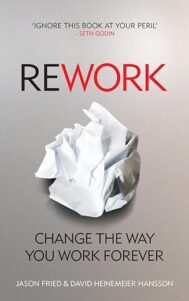
ReWork, written by Jason Fried and David H Hansson, is a book that explains how to manage a business. It is known for challenging conventional business wisdom and offering practical philosophies on work, design, and building successful, sustainable companies. The book is organized into chapters and spans approximately 275 pages. Jason Fried and David Heinemeier Hansson are co-founders of the Chicago-based software company Basecamp (formerly 37signals) and are renowned business authors. Together, they have co-authored bestsellers such as Rework and It Doesn’t Have to Be Crazy at Work.
Key points of the book
- Planning & Workaholism: There are many factors beyond our control; therefore, long-term business planning is often a fantasy. Plans longer than a few pages usually end up as fossils in a file cabinet. Working more does not mean you care more or accomplish more, it simply means you work more. Workaholics aren’t heroes. They don’t save the day; they just use it up. The real hero is already home because she figured out a faster way to get things done.
- Business vs Start up: Start a business, not a start-up. A start-up is often seen as a magical place, a place where expenses are someone else’s problem and revenue isn’t an immediate concern. But start-ups try to ignore reality. They are run by people attempting to postpone the inevitable. When you want something badly enough, you make the time regardless of your other obligations. The perfect time never arrives. You are always too young, too old, too busy, too broke, or something else. If you constantly fret about timing everything perfectly, it will never happen.
- Embrace constraints: “I don’t have enough time, money, people, or experience” are just excuses. Less is a good thing—constraints are advantages in disguise. Limited resources force you to make do with what you have. There is no room for waste, and that necessity drives creativity.
- Checklist for what you do: It is easy to put your head down and simply work on what you think needs to be done. It is much harder to lift your head up and ask why. Ask yourself the following questions:
- Why are you doing this?
- What problem are you solving?
- Is this actually useful?
- Are you adding value?
- Will this change behaviour?
- Is there an easier way?
- What could you be doing instead?
- Is it really worth it?
- Interruption: Interruptions break your workday into a series of fragmented moments. Long stretches of uninterrupted alone time are when you are most productive. A successful period of focused work requires letting go of constant communication. One of the worst interruptions to productivity is meetings. Most meetings are useless, avoid unnecessary ones.
- Good Enough is fine: When “good enough” gets the job done, go for it. It is far better than wasting resources – or worse, doing nothing because you cannot afford complex solutions. And remember, you can often turn “good enough” into great later.
- Work & Sleep: Work is important, and so is sleep. Forgoing sleep is a bad idea. You may gain a few extra hours now, but you will pay heavily later. Lack of sleep destroys your creativity, morale, and attitude. Skipping sleep can only give you exhaustion, not success.
- Sutbborneness
- Lack of creativity
- Diminished morale
- Irritability
- Long to-do list: Start making smaller to-do lists. Long lists collect dust and become guilt trips. The longer the list of unfinished items, the worse you feel about it. At a certain point, you stop looking at it altogether because it makes you feel bad. Then you stress out, and the whole thing turns into a big mess.
- Learn to say “No“: It is easy to say “Yes.” Start building the habit of saying “No”, even to many of your best ideas. Use the power of “No” to get your priorities straight. You rarely regret saying “No,” but you often end up regretting saying “Yes.” People avoid saying “No” because confrontation makes them uncomfortable. But the alternative is even worse: you drag things out, make them complicated, and spend time on ideas you don’t truly believe in.
- Four-letter words: There are certain four-letter words you should avoid using in business. These include need, must, can’t, easy, just, only, and fast. Such words often get in the way of healthy communication. When you use them, you create a black-and-white situation. Here are a few alternatives to these words: instead of saying need, try maybe or what do you think about this?
Conclusion
Rework is a must-have book for any entrepreneur – new or experienced. It offers many ideas to boost productivity and provides fresh insights on how to start and grow a business. The book is available for purchase on amazon.
Disclaimer: I express my own views in this article after reading the book, without intending to offend anyone. I do not sponsor or endorse anyone, and any resemblance to actual persons, living or dead, is purely coincidental. The mentioned link is an affiliate link, and purchasing the book through it is a great way to support me if you’d like to read along!
EA00189