
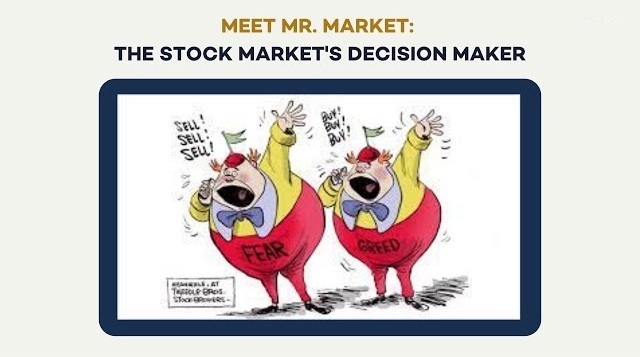
Mr. Market is an imaginary business partner. Every day he knocks on your door and quotes a price for what he thinks your business is worth. Mr. Market’s moods are highly unstable, and his valuations are determined as much by how he feels as by how your business is actually performing. Usually, he names a price that seems roughly reasonable. But on some days he is euphoric and offers an absurdly high value for the business. On other days he is deeply miserable and quotes an absurdly low number. Before he knocks, you never know what mood he’ll be in. The more extreme his mood swings, the more intensely he will pressure you to trade with him at the ridiculous prices he proposes. Time and again, Mr. Market tricks people into changing their minds: one day he scares them into selling everything, the next he tempts them to buy more recklessly. In many cases, he ends up making the decision for them. This concept of Mr. Market is well explained in the book The Intelligent Investor by Benjamin Graham.
How Mr. Market Messes with Your Mind
Listening to Mr. Market will obliterate your individuality. Once you begin to conform with the crowd, your mind is no longer entirely your own. Being part of the crowd feels safer—especially if you are a novice, facing unfamiliar challenges, or taking on high risks. The internet and social media create borderless communities in which thousands, even millions, can focus together on the same topic or event. When everyone has simultaneous mutual access to information, each person can immediately see and hear that all are paying attention to the same thing at the same time. In this state of shared attention, you can feel other people’s minds converging with your own. Your experience becomes collective. Your confidence surges from knowing you are not alone in what you believe. You become “We.” Technology has turned Mr. Market into a monster.
How Mr. Market Messes with Your Heart
The emotional mood swings of the stock market can wreak havoc on your feelings. Psychologists have shown that emotions shape both our perceptions and our actions—creating unconscious biases that can govern our behavior even if we are never aware of them. Even a faint whiff of emotion can skew your decisions:
1. Anger: Anger fires up urgency, confidence, and the sensation of being in control. Angry people rely more on snap judgments. They also believe good things are more likely—and bad things less likely—to happen to them than to others. Angry people, especially men, tend to take greater risks.
2. Anxiety: Anxiety makes you more sensitive to the magnitude of a possible reward than to the probability of receiving it. Long-shot bets look better when you are anxious, especially if you have been losing money.
3. Loneliness: Loneliness can make you less likely to seek out information that could contradict what you already believe. It can also increase your anxiety, impair your reasoning, and shred your attention span.
4. Sadness: Sadness makes people prefer smaller rewards sooner over larger rewards later. It can also raise the price you are willing to pay to buy something you don’t own. Feeling sad makes riskier bets more attractive and deferring gratification more difficult. Sadness is emotional poison for patience.
5. Stress: Stress impairs working memory and makes focusing on long-term goals difficult; it can lead to perseveration, in which people follow the same failing behaviors regardless of feedback. Under stress, you might jump to conclusions and neglect novel solutions to problems. Stress can also trigger increased risk-taking.
How to Deal with Mr. Market
Suppose today the stock market crashed more than 30%. Your phone starts blaring with news alerts, recommendations, and suggestions. Television pundits are shrieking that everyone should sell everything; friends and family are texting you to dump your stocks while you still can. Your heart starts racing, your muscles tense up, and your palms are sweating. Mr. Market is red in the face as he bangs on your door today (because the market is down 30%), yelling that every dollar you had in stocks yesterday is now worth less than 70 cents. In such a situation, go to a quiet room and ask yourself the following questions.
- Other than stock pries, when specific aspects of the businesses you own have changed?
- How large a tax bill would you incur if you sell?
- It this stock or fund were a gift rather than a purchase, would you return it to the person who gave it to you now that its fallen in price?
- Has this stock or fund ever gone down this much before? If so, would you have done better if you had sold our – or if you had bough more?
- If you liked this asset well enough to buy it at a higher price, should not you like it more now that the price has fallen.
Such questions will take some research to answer – which is as it should be. This way, you stop, Mr. Market’s overreactions to a change in price from contaminating your view of underlying value. He might be right; he might be wrong.
You can use the same approach whether a sing stock, and industry or the entire market collapses. You can also invert the question whenever prices go up farther and faster than you expected.
Sooner or later, Mr. Market will go off the rails. You could buy the book “The Intelligent Investor” by Benjamin Graham on amazon.
Disclaimer: I express my own views in this article after reading the book, without intending to offend anyone. I do not sponsor or endorse anyone, and any resemblance to actual persons, living or dead, is purely coincidental. The mentioned link is an affiliate link, and purchasing the book through it is a great way to support me if you’d like to read along!
EA00198