
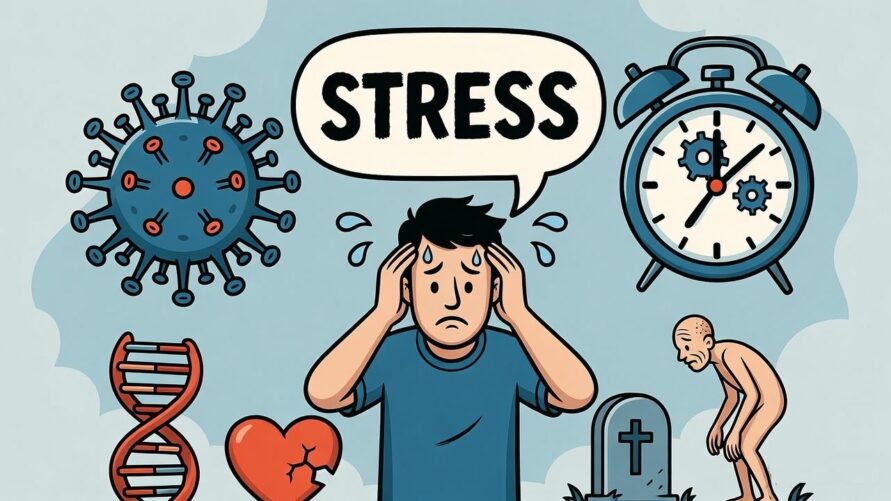
Many people appear older than their actual age due to premature aging, and research shows chronic stress plays a major role. During periods of crisis, the body breaks down faster, accelerating degenerative processes. The American Institute of Stress has concluded that stress contributes to the majority of health problems. In a study at Heidelberg University Hospital, researchers subjected a young doctor to a highly stressful simulated job interview, combined with 30 minutes of complex math problems. A subsequent blood sample revealed that his antibodies reacted to the stress similarly to how they respond to pathogens activating immune-response. While this defends against harmful agents, it also damages healthy cells, causing them to age prematurely. Similarly, studies from the University of California demonstrate that stress weakens protective structures called telomeres. These caps at chromosome ends influence cellular regeneration and aging; greater stress leads to faster shortening and more degenerative effects on cells. Bookmark this article so you can easily return to it whenever you need a boost of inspiration or want to revisit the key points. Having it saved ensures you can refresh your memory and stay connected to the ideas that matter most.
How Does Stress work?
In today’s fast-paced world, people live at a frantic rhythm, locked in near-constant competition. This intense environment triggers stress as a natural bodily response to perceived threats or problems.
When the brain detects alarm, neurons signal the pituitary gland to release hormones that stimulate corticotropin. This hormone travels through the sympathetic nervous system to activate the adrenal glands, prompting the release of adrenaline and cortisol. Adrenaline accelerates heart rate and breathing, primes muscles for action, and readies the body to confront danger. Cortisol elevates blood glucose and dopamine, energizing us to meet demands and stay “charged up.” In moderation, these processes are beneficial, they empower us to overcome daily obstacles. However, the chronic stress common today turns harmful. Prolonged “fight-or-flight” mode damages memory-related neurons, suppresses key hormones, and can lead to depression over time due to its cumulative degenerative impact.
How to Reduce Stress?
Stress is easily identifiable condition that not only causes anxiety but is also highly psychosomatic, affecting everything from our digestive system to our skin. This is why prevention is so important in avoiding the toll that stress takes on us and why many experts recommend practicing mindfulness. Key ways to control stress according to the book include:
- Practice mindfulness and meditation — These help calm the mind, focus attention on the present moment, and prevent rumination that fuels chronic stress. Train your mind to stay fully present in the current moment. It helps you observe your thoughts without judgment, reduce stress and anxiety, improve focus, and cultivate inner calm through regular practice.
- Live slowly and take it easy — One of the rules of ikigai is to avoid rushing; adopt a calm, unhurried pace (similar to “take it slow”) to lower daily pressure. Live slowly and take it easy means intentionally slowing down your pace of life. Instead of rushing through everything, it encourages you to relax, enjoy the present moment, reduce stress, and avoid constant busyness. It’s about choosing a calmer, more mindful way of living with less pressure and more peace.
- Stay active without overdoing it — Engage in gentle, consistent movement (like walking or gardening) and avoid retirement to maintain purpose, which buffers against stress. Stay active without overdoing it means keeping your body moving regularly through exercise or daily movement, while avoiding excessive strain or burnout. It promotes consistent, moderate activity that builds strength, improves mood, and boosts energy without pushing yourself too hard or risking injury.
- Nurture strong social connections — Surround yourself with good friends and community (moai groups in Okinawa), as social support reduces isolation and emotional strain. Nurture strong social connections means actively building and maintaining deep, meaningful relationships with family, friends, and community. It involves spending quality time, offering support, and staying emotionally connected. These bonds provide belonging, reduce loneliness, improve mental health, and create a strong support system that enhances overall happiness and resilience.
- Achieve flow in activities — Pursue your ikigai (purpose at the intersection of what you love, are good at, the world needs, and can be paid for) to enter “flow” states that naturally dissolve stress and bring fulfillment. Achieve flow in activities means becoming fully immersed in what you’re doing, so deeply focused that time seems to disappear. In this state, you feel energized, highly productive, and enjoy the task effortlessly. It happens when the challenge matches your skill level, leading to peak performance, creativity, and genuine satisfaction.
- Keep stress away through anti-aging habits — Combine with practices like hara hachi bu (eat to 80% full, follow the 80 percent rule), adequate sleep, and resilience-building routines to minimize cortisol’s harmful effects. Keep stress away through anti-aging habits means adopting daily practices like mindfulness, exercise, good sleep, and healthy eating that naturally lower stress levels. These habits not only reduce anxiety and cortisol but also slow down the aging process by protecting your body and mind, helping you stay youthful, energetic, and calm from the inside out.
A Little stress is good for you
After observing a group of test subjects for more than 20 years Dr. Howard S. Friedman, a psychology professor at the University of California discoverred that people who maintained a low level of stress, who faced challaenges and put their heart and soul into their work in order to succeed, lived longer than those who close a more relaxed lifestye and retired earlier. From this he concluded that a small does of stress is a positive thinkg, as those who live with low lvelves of stress tend to develop helathier habits, smoke less and drink less alchohol.
Antiaging Technique or attitude
Spending too much time seated at work or at home not only reduces muscular and respiratory fitness but also increase appetite and curbs the desire to patriciate in activities and eventually leads to early aging. Being sedentary can lead to hypertension, imbalanced eating, cardiovascular disease, osteoporosis and even certain kinds of cancer. Make some changes in your life style to reduce aging
- Walk as much as possible to work or just go on a walk for at least twenty minutes each day.
- Use your feet instead of an elevator or escalator. This is good for your posture, your muscles, and your respiratory system among other things.
- Participate in social or activities so that you don’t spend too much time in from of the television.
- Replace your junk food with fruit and you will have less of an urge to snack, and more nutrients in your system.
- Get the right amount of sleep. Seven to nine hours is good, but any more than that makes us lethargic.
- Play with children or pets, or join a sports team. This not only strengthen the body but also stimulates the mind and boosts self-esteem
- Be conscious of your daily routine in order to detect harmful habits and replace them with more positive ones.
Conclusion
In our fast-paced world, stress is an unavoidable part of daily life. We can’t fully escape it, nor should we try to eliminate. Moderate, short-term stress sharpens focus, boosts performance, and helps us meet challenges. But when stress turns chronic and prolonged, it becomes destructive. Research shows it triggers the same immune overreaction as a pathogen: damaging healthy cells, shortening telomeres, accelerating cellular aging, and quietly stealing vitality and healthy years. Proven strategies, like practicing mindfulness, slowing down, building strong social connections, staying gently active, pursuing purpose (ikigai), and embracing mindful eating (hara hachi bu), can greatly reduce its harmful effects. Ultimately, managing stress isn’t about avoiding life’s pressures entirely, but handling them wisely. The choices we make today decide whether stress accelerates our aging… or becomes a manageable companion on the path to a longer, healthier, more vibrant life. You could buy the book Ikigai on amazon.
Disclaimer: I express my own views in this article after reading the book, without intending to offend anyone. I do not sponsor or endorse anyone, and any resemblance to actual persons, living or dead, is purely coincidental. The mentioned link is an affiliate link, and purchasing the book through it is a great way to support me if you’d like to read along!
EA00203