
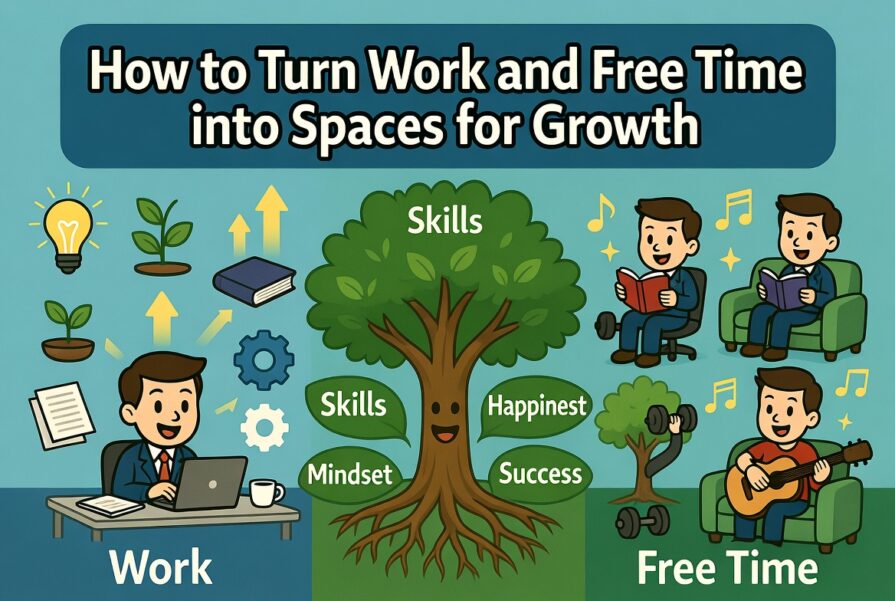
Until you discover your Ikigai, stay engaged in meaningful work, even if it is not something you love or plan to do forever. Every experience can help you learn, grow, and move closer to your purpose. We have all experienced moments when time seems to disappear while doing something we enjoy, and how slowly it passes when we are doing something we dislike. Although there is no guaranteed formula for happiness or finding your Ikigai, developing a state of flow is an important step. Flow occurs when you are fully immersed in an activity, making work more enjoyable while helping you build skills, confidence, and fulfillment. Over time, these experiences can guide you toward a more purposeful and satisfying life. Bookmark this article so you can easily return to it whenever you need a boost of inspiration or want to revisit the key points.
In order to achieve this optimal experience, we need to focus on increasing the time we spend on activities that bring us into a state of flow, rather than allowing ourselves to become absorbed in activities that provide only immediate pleasure, such as overeating, abusing drugs or alcohol, or bingeing on chocolate in front of the TV. According to research, there are seven conditions for achieving a state of flow in what we do. These seven conditions are outlined below:
- Knowing what to do
- Clarity of goals and tasks. You understand the objective and the steps required.
- You can prioritize tasks and avoid working on irrelevant things.
- Example: A student knows the assignment is to write a 1,000-word essay on climate change.
- Knowing how to do it
- Having the right methods, strategies, or skills to accomplish the task.
- Reduces trial-and-error frustration.
- Example: The student knows how to research, outline, and structure an essay.
- Knowing how well you are doing
- Feedback and self-monitoring. You can measure progress and adjust if needed.
- Encourages motivation when progress is visible.
- Example: Checking a draft against a rubric or receiving teacher feedback.
- Knowing where to go
- Direction for improvement or next steps. This prevents stagnation.
- Prevents stagnation or aimless effort.
- Example: After finishing the essay, the student knows to submit it online and prepare for a presentation.
- Perceiving significant challenges
- Recognizing that the task is demanding enough to stretch your abilities.
- This balance keeps engagement high.
- Example: The essay requires synthesizing multiple sources, not just summarizing one.
- Perceiving significant skills
- Awareness of your own competence and strengths. Confidence that you can meet the challenge.
- Helps you match skills to challenges effectively.
- Example: The student realizes they are good at critical analysis and can apply that skill.
- Being free from distractions
- Focused attention without interruptions. Essential for deep work and flow.
- Prevents wasted time and mental fatigue.
- Example: Turning off notifications and working in a quiet space.
If you often find ourself losing focus while working on something you consider important, there are several strategies you can employ to increase your chances of achieving flow.
Strategy 1: Choose a difficult task (but not too difficult)
Schaffer’s model encourages us to take on tasks that we have a reasonable chance of completing but that are slightly outside our comfort zone. Every task, sport, or job has a set of rules, and we need a certain set of skills to follow them. If the rules for completing a task or achieving a goal are too simple relative to our skill level, we will likely become bored. Activities that are too easy lead to apathy. On the other hand, if we take on a task that is too difficult, we will not have the skills required to complete it and will almost certainly give up. Therefore, we must find a middle path. Add a little extra, something that pushes you beyond your comfort zone. We want to see challenges through to the end because we enjoy the feeling of pushing ourselves. As Bertrand Russell said:
To be able to concentrate for a considerable amount of time is essential to difficult achievement
Strategy 2: Have a clear, concrete objective
According to a study by Boston Consulting Group, when employees at MNC were asked about their managers, their number one complaint was that their managers did not communicate the team’s mission clearly. As a result, employees often did not understand their objectives. It is far more important to have a compass pointing toward a clear destination than to have a map. This does not mean you should begin your journey without any idea of where you are going. Rather, it means understanding that, although the path to your goal may not be straight, you will reach it faster and more efficiently than if you rigidly followed a preplanned route. Having a clear objective is important for achieving a state of flow, but we must also know when to leave it behind and focus fully on the task at hand.
Strategy 3: Concentrate on a single task
This is perhaps one of the greatest obstacles we face today, with so much technology and so many distractions. We are listening to a vide on YouTube while writing an e-mail, when suddenly a chat prompt pops up and we answer it. then our smartphone vibrates in our pocket; just as soon as we respond to that message, we’re back at our computer, logging on to Facebook. Our brains can take in millions of bits of information but can only actually process a few dozen per second. When we say we are multitasking, what we are really doing is switching back and forth between tasks very quickly. Unfortunately, we are not computers adept at parallel processing. We end up spending all our energy alternating between tasks, instead of focusing on doing one of them well. According to Csikszentmihalyi in order to focus on a task we need:
- To be in a distraction-free environment
- To have control over what we are doing at every moment.
As said beautifully
Concentrating on one thing at a time may be the single most important factor in achieving flow.
By embracing the Seven conditions and Three strategies outlined above, you can transform both your work and your free time into purposeful spaces for growth. These principles not only help you stay focused and motivated but also ensure that every challenge becomes an opportunity to strengthen your skills, deepen your learning, and move closer to your goals. In essence, growth is not confined to formal settings — it can be woven into the fabric of everyday life when approached with clarity, balance, and intention.
Disclaimer: I express my own views in this article after reading the book, without intending to offend anyone. I do not sponsor or endorse anyone, and any resemblance to actual persons, living or dead, is purely coincidental. The mentioned link is an affiliate link, and purchasing the book through it is a great way to support me if you’d like to read along!
EA00210